There’s a particular kind of humility that comes from working with an industry that has seen every sales training fad come and go. Insurance companies (especially large, distributed ones) have tried it all. Classroom workshops, e-learning modules, gamified assessments, digital certifications.
But when you sit with their sales leadership, you may often have no answer to the question: are your frontline teams actually selling better?
Working closely with one of India’s leading insurance organizations on their sales enablement journey was one of the most instructive experiences for us in understanding where enterprise learning breaks down and what it actually takes to fix it.
The Missing Link Between Learning and Sales Performance
The instinct in most organizations is to respond to a performance problem with a content problem. Conversion rates are low? Create more product knowledge modules. Advisors struggling with objections? Build a FAQ library. Renewal conversations going nowhere? Mandate a refresher course.
But what we consistently observed (and what the data eventually confirmed) was that the gap wasn’t informational. Advisors could pass knowledge assessments. They could recite product features and explain policy terms. The breakdown happened the moment they were in front of a customer, navigating a real conversation with all its unpredictability: a hesitant buyer, a skeptical family member, a price objection delivered with frustration.
Information lives in the head. Performance lives in the moment. And no amount of content bridges that gap on its own.
What Actually Moves the Needle: Lessons from the Field
This is where the work got genuinely interesting and where the insights came from observation, not theory.
Sharing some in this piece:
1. Practice has to feel real to change real behavior
Generic role play scenarios — “pretend you’re a customer asking about premiums” — don’t replicate the texture of an actual sales conversation. The tone, the resistance, the cultural nuance of a hesitant buyer in a tier-2 city are all absent. When simulations mirror the specificity of real situations, something different happens in the learner. The stakes feel real. The response becomes instinct, not recall.
2. Feedback delayed is feedback wasted.
In most training programs, a manager might observe a call, take notes, and share feedback in a weekly review — days later. By then, the emotional memory of that specific interaction has faded. Immediate, granular feedback — on tone, on word choice, on how a pitch landed — is fundamentally different. It connects the behavior to the outcome in real time, which is when the brain is most receptive to change.
3. Scale creates a consistency problem that most organizations underestimate.
A large insurance workforce spread across geographies isn’t just a logistics problem. It’s a quality problem. The quality of coaching that a frontline advisor in a metro receives versus a peer in a smaller market can be dramatically different. When the quality of practice depends on the quality of the manager, you’ve essentially made performance a lottery. Any serious enablement strategy has to decouple skill development from managerial bandwidth.
4. Personalization isn’t just a feature.
Different advisors have different gaps. A new joiner and a five-year veteran walking into the same training room have almost nothing in common in terms of what they need. Yet most programs treat them identically. The ability to identify where an individual specifically struggles — objection handling versus rapport-building versus closing — and direct practice accordingly is not a nice-to-have. It’s what separates programs that show up in performance metrics from those that show up only in completion reports.
5. Language and culture are not edge cases.
This one is often treated as an afterthought — a checkbox for regional compliance. But the reality for a workforce serving customers across diverse states and languages is that the conversation itself changes fundamentally. An advisor explaining a term plan to a customer in Tamil sounds and feels different than one in Hindi or Marathi. The idioms, the persuasion logic, the trust signals — all of it shifts. Enablement that ignores this is enablement that works only on paper.
6. Data at the individual level changes the conversation with leadership.
One of the most underrated shifts that happened through this engagement was what it did for HR and L&D’s credibility with the business. When you can show — not anecdotally, but with actual data — that advisors who completed certain simulation modules converted 18% better on renewal conversations, the discussion about learning investment changes entirely. You’re no longer defending a budget. You’re showing a return.
Wrapping Up
What this engagement reinforced, above all else, is that the last mile of learning — the moment where knowledge either becomes performance or doesn’t — is the most important and most neglected part of the entire enablement chain.
Organizations invest heavily in content, platforms, and delivery. They spend far less on the rehearsal infrastructure that turns all of that into actual capability. And in a field like insurance sales, where trust is built in conversation and advisors are often the only human touchpoint a customer has, the quality of that last mile is everything.
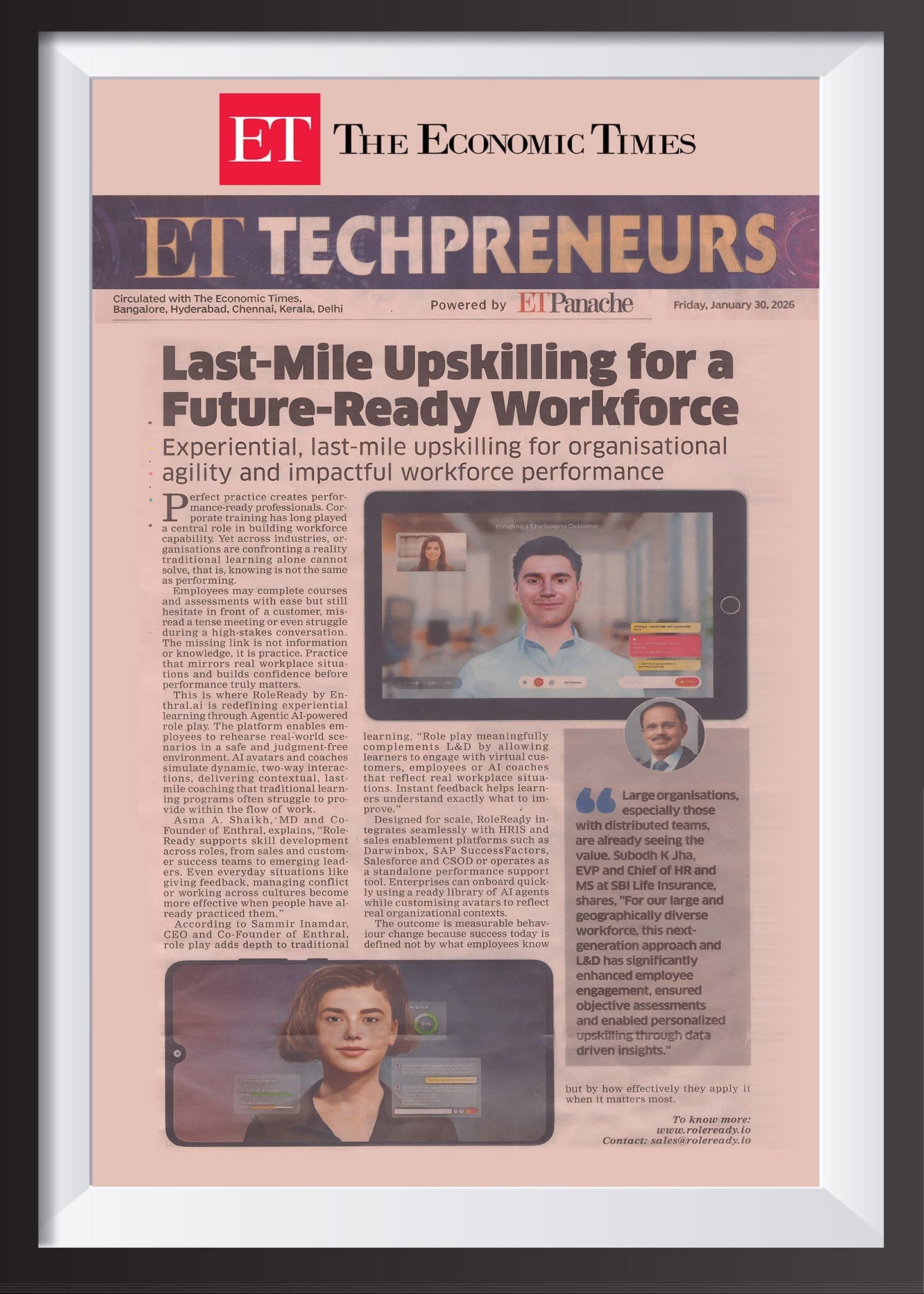
We built RoleReady for that last mile of learning. It gives sales teams the ability to practice in realistic, AI-powered simulations, before the real conversation happens. For large, distributed workforces, RoleReady’s library of ready-to-use AI agents means teams can start building real skills from day one and leaders finally get the performance data to prove it.
See what our customers say about RoleReady.